 Comparison
Deck vs Patio Resale Value: Which Recoups More at Sale?
Last Updated: November 17, 2026
Quick Summary
In the deck vs patio resale value comparison, decks tend to recoup more at resale in most markets, while patios cost less to build and hold their own in warm climates. Buyers generally pay for usable outdoor living space, not for the label on it.
- Wood decks historically recoup around half their cost at resale, while composite decks report higher returns.
- Concrete patios cost the least upfront and generally need less routine labor than a wood deck.
- Wood decks last 10-15 years, so one may need replacing before you sell and wipe out the gain.
- Sloped or uneven terrain usually pushes you toward a deck; flat lots open up both options.
- Pull three to five comparable sales with and without a deck or patio to get a local value signal.
Table of Contents
- Deck vs Patio Resale Value at a Glance
- Deck vs Patio Cost: What You Pay Upfront
- Deck vs Patio Pros and Cons for Home Value
- Wood Deck vs Patio Resale Value Comparison
- Deck Maintenance and Lifespan vs Patio Upkeep
- Net Return After Maintenance and Replacement Costs
- Matching the Choice to Your Yard, Climate, and Buyers
- Planning Your Deck or Patio Project With a Local Contractor
- Frequently Asked Questions
Deck vs Patio Resale Value at a Glance
The deck vs patio resale value comparison comes down to a simple split: decks tend to recoup more at resale in most markets, while patios cost less to build and hold their own in warm climates. Across the greater Charleston and Huntington area, buyers generally pay for usable outdoor living space, not for the label on it.
National averages hide the details that decide your number: cost recouped depends on materials, your yard, and neighborhood expectations. Below, we break down the deck vs patio cost gap, the pros and cons for home value, and how to run the math for your property.
The ROI and Lifespan Comparison Table
| Factor | Wood Deck | Composite Deck | Concrete Patio | Paver Patio |
|---|---|---|---|---|
| Typical upfront cost | Lower | Highest | Lowest | Mid-range |
| Expected lifespan | 10-15 years | 25+ years | 25-30 years | 25+ years |
| Annual upkeep | Staining, sealing, board repair | Washing only | Occasional crack repair | Re-sanding joints, weed control |
| Buyer appeal | Strong in most markets | Strong, low-maintenance pitch | Neutral to positive | Strong, premium look |
| Resale return | Moderate | Highest reported | Moderate | Moderate to high |
| Best for | Tight budgets, sloped yards | Long-term homeowners | Warm climates, flat lots | Flat lots, curb appeal |
The table shows the trade-off at a glance: the cheapest option to install rarely recoups the most, and the priciest needs time to pay back. Lifespan matters as much as cost, a surface that needs replacing before you sell recoups nothing.
Deck vs Patio Cost: What You Pay Upfront
Published cost guides put basic concrete patios in the low double digits per square foot and decks well above that, with composite at the top. Treat any per-square-foot figure as a starting point, not a quote, size, access, slope, and material grade move the number more than the national average.
Here is what most cost articles skip: the deck vs patio cost comparison only matters next to resale. A cheaper patio that recoups a smaller share can still net more dollars than an expensive deck that recoups a larger share, because you spent less to begin with. We run that math below.
Deck vs Patio Pros and Cons for Home Value
Decks win on perceived value in most markets. Buyers see an elevated structure as extra living space, and appraisers treat a well-built deck as a genuine improvement rather than a landscaping feature.
Decks add value because:
- They extend usable square footage, especially on sloped or uneven terrain where a patio is impractical
- They read as a finished room outdoors to buyers touring in spring and summer
- Composite decking appeals to buyers who do not want a maintenance project
Decks cost you because:
- Wood needs staining and sealing, and a neglected deck looks worse than no deck at all
- Elevated structures need proper footings and railings, which raises installation cost
- Older wood decks can scare buyers who assume rot and repair bills
Patios add value because:
- They cost less, so the dollars at risk are smaller
- Concrete and pavers hold up to weather with minimal attention
- A paver patio reads as a premium feature in the right yard
Patios cost you because:
- A flat slab limits you on sloped lots without a retaining wall
- Concrete cracks, and patched cracks are visible to any buyer who looks
- Ground-level surfaces do less to expand perceived living space
Wood Deck vs Patio Resale Value Comparison
The wood deck vs patio resale value comparison is where most guides get vague, so here is the practical version. Wood decks historically recoup around half their cost at resale, according to figures cited in UltraLox's guide to deck and patio resale value, which puts a typical wood deck project in the range of recouping roughly half of what you spend.
What those averages miss is method. The widely quoted return figures come from national cost-versus-value surveys that compare average project cost to average value added at sale. They do not adjust for your neighborhood, your climate, or how well the structure was built. A deck that fails inspection adds nothing.
Recoup percentages vary substantially by source, year, and project scope. Some figures represent cost recouped, the share of your investment returned at sale, while others represent added market value, a different number entirely.
The source and year of an ROI figure matter as much as the number. A figure from a national survey in a strong housing market may not hold in a slower market or a region where outdoor living is less of a priority. When you see a recoup percentage, ask: Who published it? What year? What project scope?
Our take: use the national benchmark as a floor and ceiling, not a promise. Markets with long outdoor seasons and buyers who entertain recoup better on both surfaces; soft markets or awkward yards recoup less. The most reliable approach is pulling comparable sales in your neighborhood with and without a deck or patio, that local delta beats any national average.
Deck Maintenance and Lifespan vs Patio Upkeep
Deck maintenance and lifespan quietly erodes deck returns. A wood deck needs cleaning, staining, and sealing on a regular cycle, plus board replacement as rot sets in. Composite cuts that to washing, but costs more upfront and still needs a proper frame.
Patios ask for less. Concrete and pavers generally need less routine labor than a wood deck.
Lifespan favors the harder surfaces. Wood decks generally need replacement sooner than composite, concrete, or paver surfaces. Over a long hold, a wood deck may need replacement before you sell, wiping out the resale gain entirely.
Net Return After Maintenance and Replacement Costs
Net return is what you actually keep after upkeep, and it is the number most ROI articles never calculate. Here is how we would run it for a homeowner deciding between the two:
- Estimate the installed cost of each option for your yard
- Add expected maintenance over your planned hold period
- Add the probability-weighted cost of repair or replacement
- Subtract both from the value each option is likely to add at sale
A wood deck with a lower sticker price can lose its edge once you add a decade of staining and a board replacement. A composite deck costs more but asks for almost nothing after installation. A concrete patio starts cheapest and stays cheap, which is why it often nets out competitively even when its gross return looks smaller.
Watch out: homeowners routinely compare gross ROI percentages from national surveys and skip the maintenance line entirely. That single omission flips the answer in plenty of cases, especially for wood.
Matching the Choice to Your Yard, Climate, and Buyers
The right surface depends on your yard before it depends on your budget. Sloped or uneven terrain usually pushes you toward a deck, because an elevated structure handles grade changes without a retaining wall.
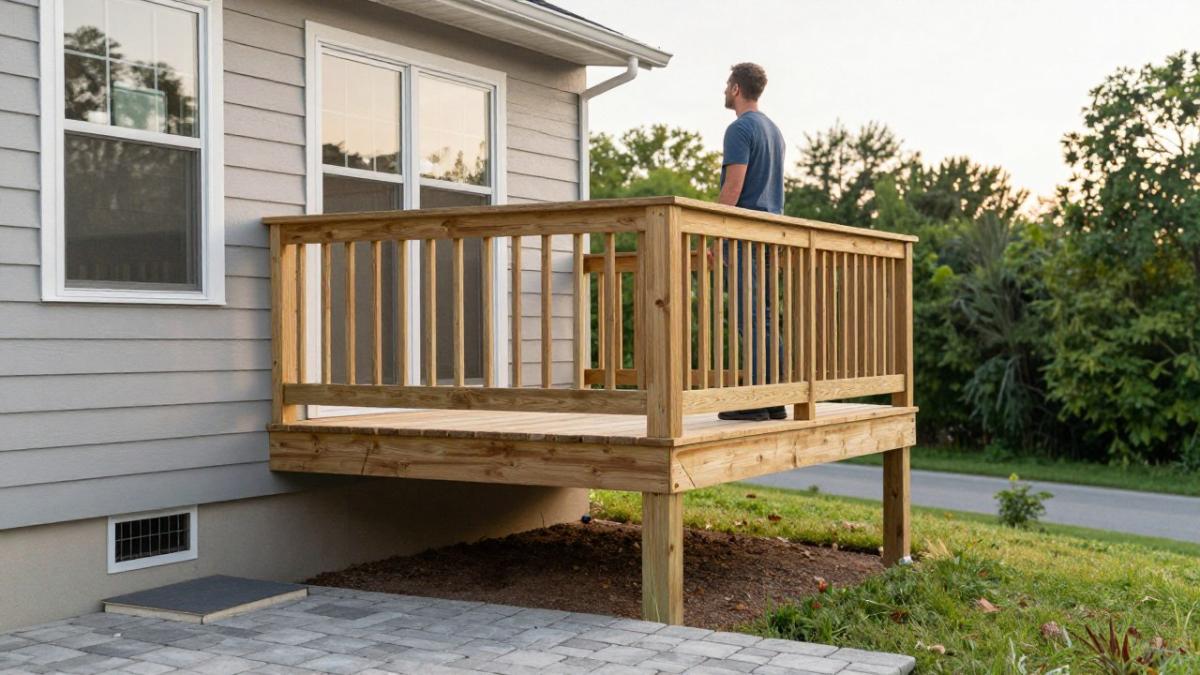
Climate shifts buyer preferences. Warm-weather regions get more patio use and appeal; areas with real seasonal swings tend to reward decks at resale because they extend the usable season.
Start with buyer demand. Note whether recent neighborhood listings with decks or patios sell faster or at a premium. A local agent can tell you what buyers in your price band ask about, some markets reward entertaining space, others low-maintenance exteriors.
Next, pull comparable sales: three to five recent sales of similar homes, some with a deck or patio and some without. The adjusted price difference gives you a local value signal national averages cannot. If data is thin, ask an appraiser or agent how they treat outdoor structures in valuations.
Property-specific constraints can change feasibility and value before materials matter. Drainage and grading: a patio must shed water away from the foundation, and a deck must not interfere with basement waterproofing.
Finally, distinguish buyer appeal from formal appraisal treatment. Resale value is not guaranteed, buyers may love a feature an appraiser values conservatively, and quality and condition affect both.
If you are planning the project as part of a larger exterior renovation, our step-by-step exterior renovation planning guide helps you sequence the work so the deck or patio fits the budget instead of blowing it.
Planning Your Deck or Patio Project With a Local Contractor
Resale value starts with construction quality, and quality starts with who builds it. Before you hire, read up on what to look for in deck construction so you know which questions to ask.
If you would rather hand the project to a team that handles the whole exterior, our overview of professional deck construction services explains how the work runs from design through final inspection. And because the contractor you pick matters as much as the material, our guide to finding trustworthy exterior contractors covers licensing, insurance, and the red flags that show up before the first invoice.
At Real Property Industries, LLC, we are a licensed and insured contracting company serving the greater Charleston and Huntington area for more than seven years. Our exterior services include roofing, siding, decking, and landscaping. We aim to deliver efficient, high-quality work at honest and fair prices.
The deck vs patio decision rewards homeowners who run the net-return math instead of chasing the biggest ROI percentage. Get the yard, climate, and maintenance costs right, and either surface can pay you back at sale. Get them wrong, and the cheapest option becomes the most expensive one.
Real Property Industries, LLC can help you weigh both options against your property and your budget. We bring licensed and insured workmanship, honest and fair pricing, and more than seven years of serving the local exterior market to every project. Get started with Real Property Industries, LLC and build an outdoor space that holds its value.
Frequently Asked Questions
What adds more value, a deck or a patio?
Reported figures generally favor decks. Those numbers are national benchmarks, not guarantees. Your actual deck vs patio resale value depends on your local market, the materials you choose, and how well the structure fits the house and yard.
Does a wood deck add more resale value than a concrete patio?
In most reported comparisons, yes. Wood decks typically carry a higher upfront cost than a basic concrete patio, but they also tend to recoup a larger share of that cost at sale. Basic concrete patios generally cost less than decks, and pricing depends on size, access, and materials. The wood deck vs patio resale value comparison usually favors the deck, though a well-designed paver patio in a warm climate can close much of the gap.
Which is cheaper to maintain, a deck or a patio?
Patios generally cost less to maintain over time. Concrete and pavers need occasional cleaning and resealing, but they resist rot, insects, and moisture damage. Wood decks require staining or sealing every few years, plus periodic board replacement, and composite decks need regular cleaning. When you weigh deck maintenance and lifespan against patio upkeep, the patio usually wins on annual cost, while the deck often wins on buyer appeal and resale return.
Which lasts longer, a deck or a patio?
A concrete or paver patio typically outlasts a wood deck. Well-built patios can last several decades with basic care, while wood decks often need major repairs or replacement sooner than patios, depending on weather exposure and upkeep. Composite decking lasts longer than wood but still trails concrete. Lifespan matters for resale because buyers and appraisers factor remaining useful life into what they will pay.
What factors affect how much a deck or patio adds to home value?
Four factors carry the most weight: the upfront cost relative to your home's value, local climate and buyer preferences, condition and remaining lifespan at the time of sale, and how well the structure fits the yard and access from the house. A deck on a sloped lot with a walkout basement often adds more appeal than the same deck on a flat lot. Permitting and code compliance also matter, since unpermitted work can stall a sale or reduce what buyers offer.