 blog
5 Signs Your Siding Needs Replacement, Not Just Repair
Last Updated: October 25, 2026
Quick Summary
Siding needs replacement when damage goes beyond surface-level wear, such as rot spreading across multiple sections, soft spots indicating interior moisture damage, or widespread cracks across multiple panels. Repairs save money upfront, but replacement solves the problem permanently and is often more cost-effective long-term when repair costs approach replacement costs.
- Repair is cheaper today, but replacement is often cheaper over the next decade when accounting for future repairs.
- Siding 15+ years old with visible rot, soft spots, or interior water staining should be replaced rather than repaired.
- If damage returns within one season after repair, investigate the moisture source in the wall assembly before patching again.
- Vinyl siding more than 10 years old rarely matches new panels due to color fade and discontinued stock.
- A moisture meter reading above roughly 20% in wood framing typically triggers further inspection and often leads to replacement.
Table of Contents
- When Damage Signals That Siding Needs to Be Replaced
- Signs Siding Needs to Be Replaced: Moisture, Rot, and Hidden Damage
- Siding Repair vs Replacement Cost: The Long-Term Math
- Wood Siding Repair and Replacement: Material-Specific Decisions
- Vinyl Siding Repair vs Replace: Durability and Discontinued Stock
- Age, Warranty, and the Lifecycle Cost Framework
- Getting a Professional Siding Assessment and Repair Plan
- Frequently Asked Questions
When Damage Signals That Siding Needs to Be Replaced
The question isn't whether your siding needs replacement eventually, it's whether you're looking at a quick patch or a full replacement. The answer depends on what's happening beneath the surface.
Siding needs replacement when damage goes beyond surface-level wear. A small crack in one panel is a repair; rot spreading across multiple sections is replacement territory.
We help homeowners tell structural issues from cosmetic damage.
Signs Siding Needs to Be Replaced: Moisture, Rot, and Hidden Damage
Once moisture gets behind the outer layer, it threatens framing, insulation, and interior walls, where most homeowners miss the real problem until it's expensive to fix.
Soft spots, warping, and interior water stains
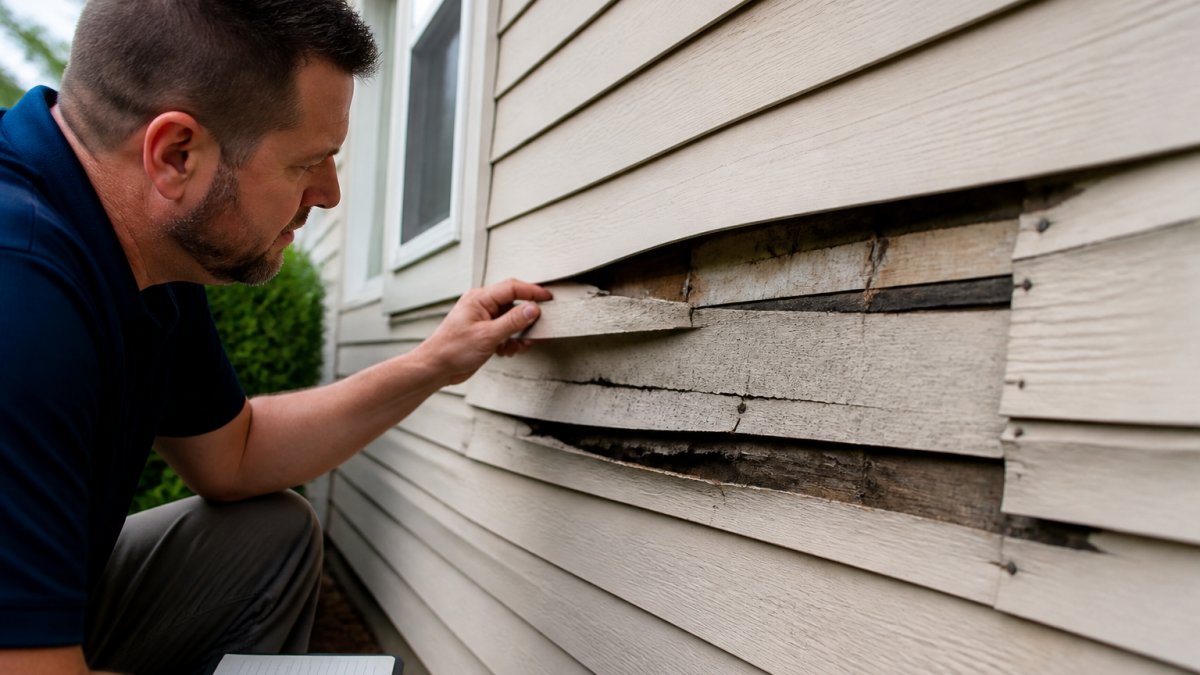
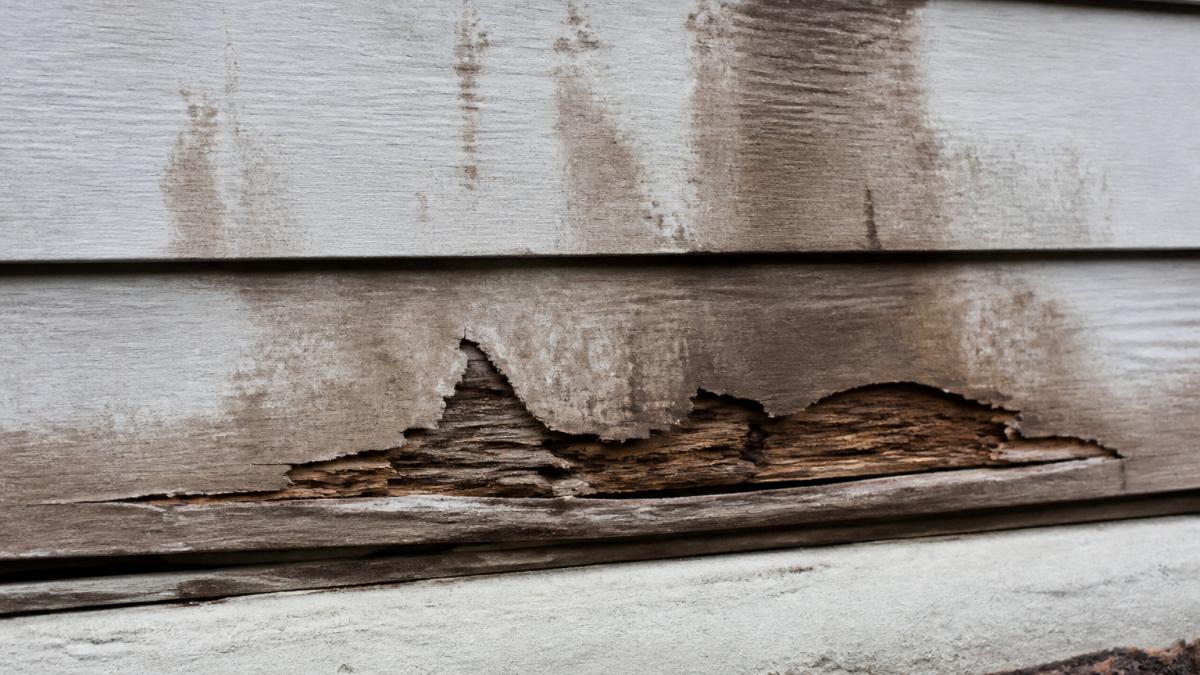
Press on your siding. If it feels spongy, water has penetrated and is breaking the material down from the inside.
Warping, siding bowing outward or pulling away, usually means moisture is trapped underneath, and interior water stains near exterior walls confirm water is entering your home.
These signs mean damage has moved beyond the siding itself: potential mold, rotted framing, and compromised insulation that repair won't address.
Visible mold, mildew, or discoloration patterns
Mold and mildew grow where moisture lingers. Dark patches that don't wash away point to moisture; mildew may be surface-level, but mold often indicates deeper intrusion.
Vertical staining usually means water is running down from a failed seam above; horizontal stains often indicate pooling at panel bases or around windows and doors.
When mold or mildew covers a large area or returns quickly after cleaning, replacement is usually the right call, the moisture source is too widespread for patching.
Widespread cracks or multiple damaged panels
One crack in one panel? Repair it. Five cracks across three sections means the material is failing overall, especially if they're spreading.
Widespread damage suggests the cause, age, weather exposure, or poor installation, affects the whole system, so patching individual panels won't stop new damage elsewhere.
Siding Repair vs Replacement Cost: The Long-Term Math
Repair almost always costs less upfront. What most homeowners miss is how quickly it becomes a cycle, fix one section, another fails six months later, eroding the savings you thought you'd locked in.
To decide, you need three numbers: the repair quote, the replacement quote, and your siding's expected remaining life.
Typical cost ranges by material
Costs vary by region, home size, and access. Pricing depends on quantity, dates, and delivery. Direct readers to Real Property Industries, LLC's website for current prices or a quote.
A two-story home with complex rooflines or tight lot access sits at the high end; a simple ranch sits lower.
The lifecycle math most homeowners skip
Here's the framework that turns those ranges into a decision, add up three things:
- The repair cost today.
- The expected cost of future repairs over the remaining life of the siding. If you repair now and expect another repair in 2-3 years, add that future cost, adjusted for inflation, to today's repair price.
- The replacement cost, minus any salvage value of the existing siding (usually zero, but occasionally the underlying sheathing or house wrap is reusable).
If items 1 and 2 approach or exceed item 3, replacement is the better financial move, often at 15+ years old with two or more repairs in the past five years.
Example: if the sum of current and expected future repairs approaches the replacement cost, repairing only makes sense if you plan to sell soon and the damage is cosmetic.
The hidden cost of repair: discovery
Repair quotes are estimates, not fixed prices. Once a contractor opens the wall, hidden rot or failed flashing can expand the scope, a $500 patch can become a $3,000 repair.
Ask each contractor how they handle change orders and what triggers a scope increase.
FTC guidance on home improvement contracts recommends getting multiple estimates and putting the scope, payment schedule, and change-order process in writing before work begins.
Wood Siding Repair and Replacement: Material-Specific Decisions
Wood siding looks beautiful when maintained, but it rots, warps, and needs regular painting or staining, which changes the repair-versus-replace equation.
When wood rot makes patching futile
Wood rot is progressive, spreading through the grain and weakening the structure. If rot is visible on the surface, it's already established inside, a patch covers the spot while rot spreads behind it.
Small, isolated rot can be cut out and patched with epoxy or replacement wood.
Once you start removing damaged wood, the rot often extends deeper than expected. Replacement eliminates that uncertainty.
Discontinued wood profiles and color matching
Older homes often used wood profiles no longer manufactured, so matching a damaged section becomes difficult or impossible, leaving a visible repair that doesn't blend.
Paint fades over time, and the exact shade may no longer be available.
If your siding is a discontinued profile or the color mismatch would be noticeable, full replacement gives you a uniform appearance and no future matching headaches.
Vinyl Siding Repair vs Replace: Durability and Discontinued Stock
Vinyl is durable and low-maintenance compared to wood, but it becomes brittle in cold, fades in sunlight, and can warp if installed too tightly.
Vinyl panels can be replaced individually, a single damaged panel comes out and a new one slides in.
If your vinyl siding is more than 10 years old, the color you need is probably discontinued. A new panel will look noticeably brighter than the aged panels around it. You can replace a whole section to blend colors, but that cost adds up quickly.
Vinyl also becomes more brittle as it ages. Repairs that work fine on newer vinyl may not hold up on older vinyl that's lost flexibility.
Age, Warranty, and the Lifecycle Cost Framework
Age alone doesn't decide repair versus replace, but it's the strongest predictor. Combine age with material type, repair history, and what's happening beneath the surface.
A threshold-based decision framework
Use this checklist to move from general advice to a specific call:
- Under 10 years old, damage localized to one or two panels, no prior repairs: Repair. The material still has most of its service life ahead, and matching is usually possible.
- 10-15 years old, two or more repairs in the past five years, damage appearing in new locations: Lean toward replacement. Repeat repairs are the clearest signal that the system is failing, not just one panel.
- 15+ years old, any visible rot, soft spots, or interior water staining: Replace. At this age, the probability of hidden damage behind the siding is high enough that patching is usually temporary.
Material-specific repairability
Not all siding repairs are equal. The material changes both the difficulty and the long-term viability of a patch.
- Vinyl: Individual panels can be unlocked and replaced, which makes localized repair the easiest of the three common materials. The catch is color fade and discontinued stock, panels more than about 10 years old rarely match new ones, and brittle aged vinyl cracks when worked. Repair is viable for isolated damage on newer vinyl; replacement is usually smarter once fading and brittleness set in.
- Wood: Repairable when rot is isolated and caught early, cut out the affected section, treat the surrounding wood, and patch with matching stock or epoxy. But wood rot spreads through the grain, and older homes often have profiles that are no longer manufactured. Repair is viable for small, accessible spots; replacement is usually the better call once rot appears in multiple locations or the profile is discontinued.
- Fiber cement: Durable and dimensionally stable, but brittle. Cracked or broken panels must be replaced rather than patched, and color-matched panels can be hard to source for older installations. Repair is limited to small areas; replacement is often the practical choice when damage is more than cosmetic.
Hidden moisture, rot, and mold: when to open the wall
Visible damage is only part of the story. Moisture behind siding shows up as soft spots, warping, interior stains, musty odors, or mold that returns after cleaning. If you see those signs, a surface-only repair will fail.
Ask the contractor to probe suspect areas and, where warranted, remove a section of siding to inspect the sheathing, house wrap, and flashing.
Warranties, insurance, and permits
Warranties protect against manufacturing defects, not weather damage, poor installation, or lack of maintenance.
Homeowners insurance typically covers sudden damage, hail, wind, impact, but not gradual deterioration such as rot or mold.
Permits are usually required for full siding replacement and sometimes for structural repairs, depending on local building codes. Ask the contractor who pulls the permit and whether the inspection is included.
Lifecycle cost and return on investment
Lifecycle cost is more than the sticker price. It includes recurring maintenance (painting or staining wood every 5-7 years, cleaning vinyl and fiber cement periodically), energy impacts from infiltration, and eventual replacement.
Siding replacement doesn't typically return its full cost at resale, but it consistently ranks among the higher-ROI exterior projects in industry cost-vs-value reporting, and it improves curb appeal immediately.
National Association of Home Builders standards for siding durability provide benchmarks for expected service life by material.
Use this framework to decide whether your siding should be repaired or replaced based on age, damage history, and material type.
| Age Range | Damage Profile | Recommended Action |
|---|---|---|
| Under 10 years | Localized to one or two panels, no prior repairs | Repair |
| 10-15 years | Two or more repairs in past five years, new damage locations | Lean toward replacement |
| 15+ years | Any visible rot, soft spots, or interior water staining | Replace |
| Any age | Damage returns within one season after repair | Investigate moisture source before repairing again |
Getting a Professional Siding Assessment and Repair Plan
Don't guess about what your siding needs.
Real Property Industries, LLC provides comprehensive exterior services. We can assess your siding to determine if it can be saved with repair or needs replacement.
A good assessment includes a visual inspection of siding surfaces, evaluation of panel integrity, and recommendations for repair or replacement. Learn about local siding installation experts who can provide professional assessment and guide your next steps.
When you're ready to move forward, Real Property Industries, LLC can handle both assessment and installation.
Many homeowners also wonder whether one contractor can handle both roof and siding work together, the answer is yes, and coordinating both projects often saves time and money.
Before hiring anyone, verify their credentials. Use this checklist to verify licensed contractors and confirm they carry proper insurance.
Frequently Asked Questions
When should you replace siding instead of repairing it?
Replace siding when damage is widespread, involves rot or structural compromise, or when the material is discontinued. If repair costs approach replacement cost, replacement is usually the better investment. Moisture damage beneath siding, mold growth, or soft spots indicating rot are signs that localized repair won't solve the underlying problem.
Is repairing old siding more cost-effective than replacing it?
Short-term, repair is cheaper. But if you're repairing the same siding repeatedly, replacement becomes cost-effective. Factor in labor: each repair visit costs money. If your siding is old and showing multiple failure points, full replacement often costs less over time than ongoing repairs and provides better weather protection and energy efficiency.
What problems can happen if damaged siding is left unrepaired?
Unrepaired cracks and holes allow water to penetrate behind the siding, causing rot in the sheathing and framing, mold growth, insulation damage, and structural deterioration. This can lead to expensive interior repairs, health risks from mold, and reduced home value. Water damage spreads quickly in humid climates and can compromise the entire wall assembly if not addressed promptly.
Can you replace only a section of vinyl siding if the original material is no longer available?
Partial replacement is possible but challenging if the original color or profile is discontinued. Manufacturers discontinue vinyl styles every few years, making exact matches difficult. You can patch with a similar color, but the mismatch may be visible. If widespread damage or rot is present, full wall or full-house replacement ensures uniform appearance and consistent weather protection across the exterior.
Your siding is one of the most important defenses your home has against weather and moisture. When it fails, the damage spreads fast. The choice between repair and replacement isn't really about the cost today, it's about whether you're solving the problem or just delaying it. If you're seeing signs that siding needs replacement, get a professional assessment before committing to repairs that might only buy you a year or two.