
 how-to
How to Verify Contractor Insurance: A Step-by-Step Guide
Table of Contents
- Why Verifying Contractor Insurance Matters
- What Is a Certificate of Insurance for Contractors
- Step-by-Step Process to Verify Contractor Insurance
- How to Check If a Contractor Is Licensed
- Questions to Ask a Contractor About Insurance
- Insured vs. Bonded: Understanding the Difference
- Red Flags and Common Mistakes to Avoid
- Frequently Asked Questions
Last Updated: September 21, 2026
Why Verifying Contractor Insurance Matters
Before hiring a contractor for roofing, siding, decking, or exterior work, you need to verify contractor insurance. This step protects you from liability and saves thousands in potential costs if something goes wrong.
An uninsured contractor injured on your property leaves you liable for medical bills and lost wages. A contractor who causes property damage makes you responsible for repairs. These scenarios are expensive and more common than homeowners realize.
Verifying contractor insurance is essential due diligence before signing any contract.
What Is a Certificate of Insurance for Contractors
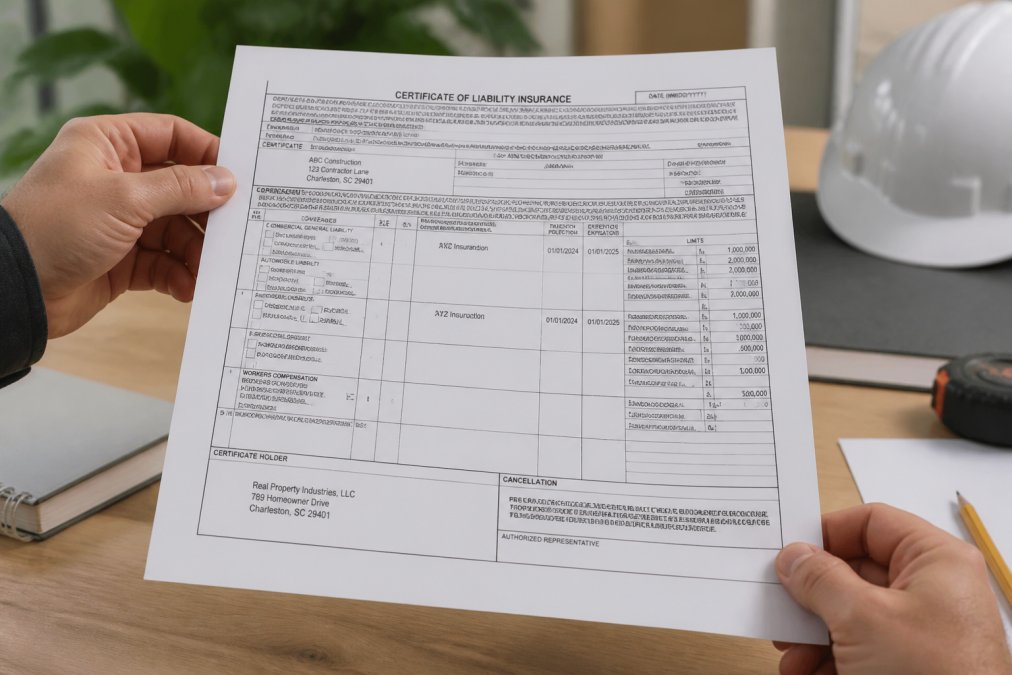
A Certificate of Insurance (COI) is an official document that proves a contractor carries active insurance coverage. It's a summary issued by the contractor's insurance agent or broker showing coverage types, policy limits, coverage dates, and the insurance carrier's contact information.
The COI is typically printed on an ACORD form (the standard template used across the insurance industry) or a carrier's branded version, both providing verifiable proof of coverage.
Key Information on the COI Document
When you receive a COI, look for these critical details:
- Contractor's name and business entity, must match exactly what you agreed to hire (e.g., "John's Roofing LLC" not just "John's Roofing")
- Insurance carrier name, the company providing coverage (e.g., Hartford, Travelers, State Farm Commercial)
- Policy numbers, a unique identifier for each type of coverage; write these down for your records
- Coverage types, General Liability, Workers' Compensation, and any specialty coverage (e.g., Umbrella Liability for high-value projects)
- Policy limits, the maximum the insurer will pay if a claim occurs (e.g., $1,000,000 General Liability)
- Effective date and expiration date, proof coverage is currently active and will remain active through your project
- Certificate holder, often listed as you (the homeowner) for additional protection; this means you're notified if the policy is cancelled
- Insurance agent or broker contact information, the person who issued the certificate; you can call them to verify details
Why the Expiration Date Is Critical
Many homeowners overlook the expiration date, and it costs them. A COI from six months ago may have already expired. If your roofing project runs from March 1 to April 15, the COI must show an expiration date of at least May 15 to account for warranty work or punch-list items.
If the expiration date is within 60 days of when you receive the COI, request proof of renewal in writing before the current policy expires. Do not assume the contractor will renew.
Understanding Policy Limits
A roofing or siding contractor should carry at least $1,000,000 in General Liability coverage; request $2,000,000 or higher for large projects.
The policy limit is the maximum the insurance company will pay for any single claim. If repair costs exceed the policy limit, you're responsible for the difference. Always verify limits are adequate for the scope of work.
How to Spot a Forged or Outdated COI
Forged certificates exist. Watch for handwritten information, blurry images, mismatched fonts, missing carrier contact information, or dates that don't make sense (effective date in the future or expiration date in the past).
When in doubt, call the insurance carrier directly using the phone number on the COI to confirm the policy is active and details match.
Step-by-Step Process to Verify Contractor Insurance
Verifying contractor insurance takes 15-30 minutes and protects your investment and property.
Step 1: Request the Certificate of Insurance
Ask for the COI early in the hiring process, ideally before the contractor provides a quote. Use email: "Please provide a current Certificate of Insurance showing General Liability and Workers' Compensation coverage. The expiration date must extend through [your project end date plus 30 days]." A contractor who refuses, delays, or offers excuses is a red flag.
Step 2: Verify Policy Expiration Dates and Project Timeline Alignment
The rule: The expiration date must extend at least 30 days beyond your project's scheduled completion date.
Step 3: Contact the Insurance Carrier Directly
Call the insurance carrier using the phone number on the COI and ask: Is the policy currently active? Are the coverage limits and dates accurate? Has the contractor made claims in the past three years? Will you notify me if the policy is cancelled or non-renewed?
Step 4: Check Subcontractor Coverage
If the contractor uses subcontractors (electricians, plumbers, HVAC specialists, framers), they must also carry insurance. Ask your primary contractor to provide COIs for all subcontractors before work starts.
- Request their COI in writing
- Verify the expiration date extends through the project
- Call their insurance carrier to confirm coverage is active
- Ask the primary contractor to list you as the certificate holder on each subcontractor's COI
Step 5: Document Everything
Create a simple file for your project that includes:
- Copies of all COIs (primary contractor and all subcontractors)
- The dates you received each certificate
- Notes from your calls to insurance carriers (carrier name, representative name, date/time, what was confirmed)
- The contractor's license number and verification of active status
- A copy of the signed contract
If a problem arises during or after the project, you have a complete record of the due diligence you performed. This protects you legally and makes it easier to file a claim if needed.
How to Check If a Contractor Is Licensed
Licensing and insurance are separate protections. A contractor can be insured but unlicensed, or licensed but uninsured. You need both.
To verify a contractor's license:
- Visit your state's licensing board website, search for "contractor license verification" plus your state name
- Enter the contractor's name or license number, results show active status, any disciplinary actions, and complaint history
- Check the license classification, confirm it covers the work you're hiring for
- Look for complaints or violations, these signal quality or safety issues
Legitimate contractors welcome this verification.
Questions to Ask a Contractor About Insurance
Before signing a contract, ask these questions directly:
About Coverage:
- What types of insurance do you carry?
- What are your policy limits for General Liability and Workers' Compensation?
- Does your coverage include damage to the homeowner's property?
About Claims:
- Have you filed any insurance claims in the past three years?
- What was the nature of those claims?
About Subcontractors:
- Do you use subcontractors for any part of this project?
- Will you provide proof of their insurance?
About Warranties:
- If something fails after the project is complete, will you fix it under warranty?
- Is that warranty backed by insurance?
Listen to how the contractor answers. Evasive responses, hesitation, or unclear explanations are warning signs. A professional contractor answers confidently and provides documentation without pushback.
Insured vs. Bonded: Understanding the Difference
These terms are often confused, but they protect you in different ways.
Red Flags and Common Mistakes to Avoid
Watch for these warning signs when evaluating a contractor's insurance:
Red Flags:
- Contractor refuses to provide a COI or delays providing one
- COI shows an expiration date that's already passed
- Insurance carrier can't confirm the policy when you call
- Contractor claims "insurance is too expensive" or "not necessary for this project"
- COI is handwritten, poorly formatted, or looks unprofessional
- Contractor offers a significant discount if you "skip the insurance verification"
- No Workers' Compensation coverage listed (required in most states for employees)
Common Mistakes Homeowners Make:
- Accepting a verbal promise of insurance instead of written proof
- Trusting the contractor's word without verifying with the carrier
- Hiring based on price alone without checking insurance status
- Not reviewing the expiration date before work begins
- Assuming the contractor's insurance covers subcontractors
- Skipping the license verification step
Frequently Asked Questions
How do you find out if a contractor has insurance?
Ask the contractor directly for a Certificate of Insurance (COI) before work begins. A COI is an official document from the insurance carrier that proves the contractor carries general liability and workers' compensation coverage. Request this in writing, and verify the policy limits and expiration dates match what you expect. You can also contact the insurance agent listed on the COI to confirm the policy is active and valid.
What is a Certificate of Insurance for contractors, and what should it include?
A Certificate of Insurance is a one-page document issued by an insurance agent that summarizes a contractor's active coverage. It shows the policyholder's name, the types of coverage (general liability, workers' compensation, professional liability), policy limits, effective and expiration dates, and the insurance carrier's contact information. It does not prove coverage in full detail, but it serves as proof that the contractor maintains active policies. Always verify the dates are current before signing a contract.
How can I verify if a contractor's insurance is currently active?
Contact the insurance company listed on the Certificate of Insurance directly using the phone number provided. Ask the insurance agent to confirm the policy is active, the coverage limits, and the expiration date. You can also ask the contractor for a recent renewal notice or declaration page. Never rely solely on the COI document, direct contact with the insurance carrier is the most reliable verification method and protects you from outdated or fraudulent documents.
What's the difference between a contractor being insured and bonded?
Insurance protects you if the contractor causes property damage or injury during the work. Bonding protects you if the contractor fails to complete the job or violates the contract terms. A contractor can be insured but not bonded, or vice versa. For exterior work like roofing or siding, you want both: general liability and workers' compensation insurance (insured), plus a performance bond (bonded). Ask the contractor which protections they carry and request documentation for each.