 how-to
Hiring Reliable Local Snow Removal: A Step-by-Step Guide
Table of Contents
- Why Hiring Reliable Local Snow Removal Matters
- Questions to Ask a Snow Removal Contractor
- Vetting Credentials: License, Insurance, and References
- Understanding Residential Snow Removal Cost and Pricing Models
- Snow Removal Contract Terms You Need to Know
- Snow Removal Service Response Time and Storm Guarantees
- Common Mistakes to Avoid When Hiring
- Conclusion
- Frequently Asked Questions
Last Updated: October 9, 2026
Why Hiring Reliable Local Snow Removal Matters
Winter weather arrives predictably, but contractor reliability often doesn't. When snow piles up on your driveway or walkway, you need someone who shows up when promised and delivers quality work without shortcuts. Hiring reliable local snow removal is the difference between a cleared property and a dangerous one, and between honest pricing and surprise bills.
The stakes are real. A contractor who ghosts mid-storm leaves you stranded. One who cuts corners on ice management creates liability on your property. One who overcharges exploits the urgency of winter weather. Real Property Industries, LLC has spent over seven years in the greater Charleston/Huntington area watching homeowners and property managers navigate these decisions, and the patterns are clear: the best outcomes come from vetting before the first snowfall, not scrambling during it.
This guide walks you through exactly how to find and hire a contractor you can trust. We'll cover the questions that matter, the credentials to verify, the pricing models to understand, and the contract terms that protect you. By the end, you'll know what separates a legitimate operator from someone cutting corners.
Questions to Ask a Snow Removal Contractor
Before you hire anyone, have a direct conversation. The right questions reveal whether a contractor understands your property and your needs, or is just looking for a quick job.
Start with the fundamentals. Ask how long they've been in business, whether they're licensed and insured, and what happens if equipment breaks down mid-storm. A contractor with storm response plans has thought about worst-case scenarios. One who hasn't is gambling with your property.
Next, ask about their service area and availability. Do they service your neighborhood? Are you a priority account or a backup? Some contractors take on too many clients and can't respond quickly when snow falls.
Get specific about what's included. Do they clear your driveway, sidewalk, and parking areas? Do they remove snow or just push it around? Will they use salt, sand, or ice melt, and do they charge extra for de-icing?
Ask about their equipment and crew. Are they using a snow plow truck, snow blower, or both? How many people show up for a typical job? A crew of one might handle small residential properties but struggle with larger commercial areas.
Finally, ask for references. Request contact information for three to five recent clients and actually call them. Ask whether the contractor showed up on time, whether the work met expectations, and whether they'd hire them again. References are the most honest feedback you'll get.
Vetting Credentials: License, Insurance, and References
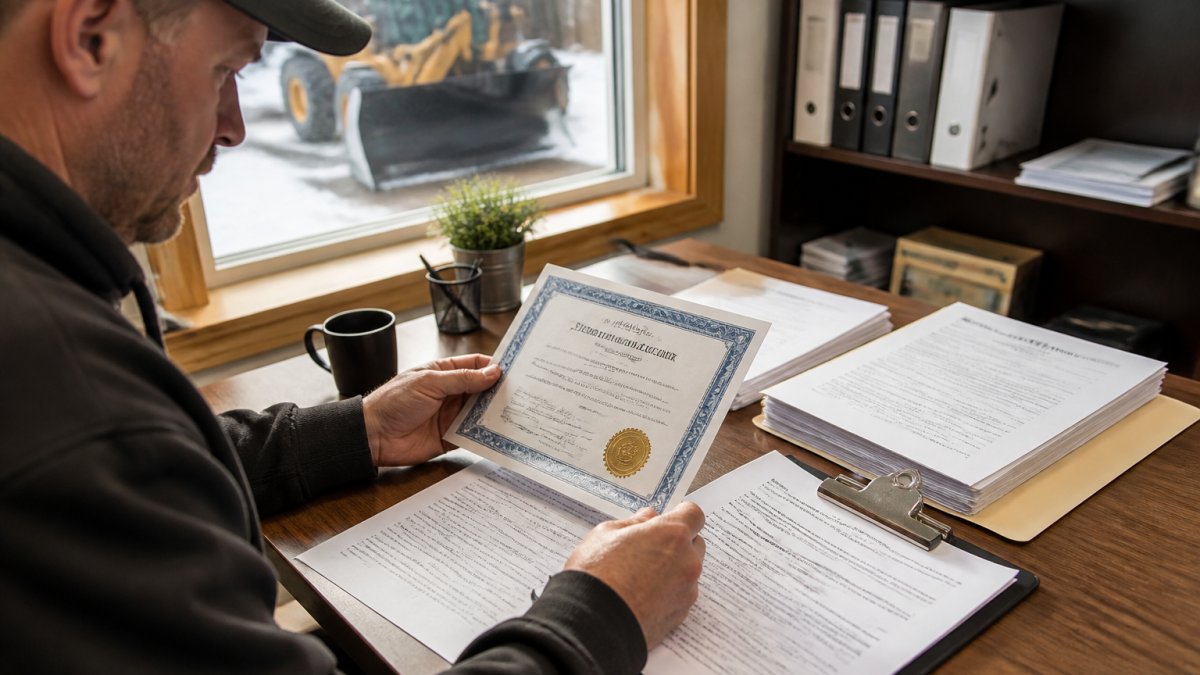
Never hire a contractor without verifying they're legitimate. This is where many homeowners cut corners, and where problems start.
Ask for proof of business licensing. A legitimate contractor carries a current license from the state or local authority. Ask to see it. If they hesitate or claim they "don't need one," walk away. Licensing exists to protect you. Unlicensed operators have no accountability if something goes wrong.
Insurance is non-negotiable. Ask for a certificate of insurance showing both general liability and workers' compensation coverage. General liability protects your property if the contractor damages your driveway or a neighbor's fence. Workers' compensation covers the contractor's employees if they're injured on your property. Without it, you could be liable.
Check references carefully. Don't just accept names, ask specific questions. How quickly did the contractor respond to snow events? Did the work quality meet expectations? Were there any disputes over pricing or service? Did the contractor communicate clearly? A reference who hesitates or gives a lukewarm answer is telling you something.
For residential snow removal, verify that the contractor understands liability. Ask what happens if their work damages your property, will they fix it at no cost? A confident contractor stands behind their work. One who dodges the question is a risk.
Understanding Residential Snow Removal Cost and Pricing Models
Snow removal pricing varies widely, and understanding how contractors charge helps you compare quotes fairly. There's no single "standard" cost, it depends on your property size, location, storm frequency, and service level.
Many contractors charge per visit. You pay a flat fee each time they clear your driveway and sidewalk. This works well if you want predictability: you know the cost upfront.
Others use hourly rates. The contractor bills for the time spent on your property. This can be fair if the work genuinely takes longer, but it creates incentive misalignment, the contractor isn't motivated to work quickly.
Seasonal contracts lock in a set price for the entire winter. You pay monthly or in one lump sum, and the contractor clears your property as many times as needed. This removes uncertainty and is often cheaper than per-visit pricing if you live in an area with frequent snow.
Some contractors charge a minimum service charge. They might offer a per-visit rate but require a minimum of, say, two inches of accumulation before they'll come out. This reduces their overhead but means you won't get cleared for every dusting. Ask about minimums upfront.
Get written quotes from at least two contractors. Compare what's included: driveway clearing, sidewalk clearing, parking areas, de-icing, snow hauling. A cheap quote that doesn't include de-icing isn't a fair comparison to one that does.
Snow Removal Contract Terms You Need to Know
Before work begins, get everything in writing. A contract protects both you and the contractor by clarifying expectations.
The contract should specify exactly what the contractor will do. Will they clear your driveway, sidewalk, and parking areas? Will they remove snow or pile it on your property?
Define the service trigger. Will they come out after every snowfall, or only after a certain accumulation? If it's accumulation-based, what's the minimum, one inch, two inches?
Specify response time. How quickly will the contractor arrive after snow stops? Some offer 24-hour response; others might take longer. For commercial properties or busy residential areas, faster response matters.
Include terms for equipment and liability. The contractor should carry insurance, and the contract should state that.
Address payment terms. When is payment due, before, during, or after service? Are there penalties for late payment? If you're on a seasonal contract, when do you pay, monthly, quarterly, or upfront?
Include a cancellation clause. If you need to end the contract early, what are the terms? Can you cancel with notice, or are you locked in? This matters if circumstances change mid-winter.
Finally, ask about guarantees. Will the contractor return if the job isn't done right? What constitutes "done right", is the driveway completely clear, or is some packed snow acceptable? Setting expectations prevents disputes.
Snow Removal Service Response Time and Storm Guarantees
When snow falls, speed matters. A contractor who responds quickly prevents your property from becoming a liability. One who delays leaves you stranded.
Ask about response time commitments. Some contractors guarantee arrival within 24 hours of snowfall. Others aim for 48 hours. For residential properties, 24-hour response is reasonable; for commercial properties with high foot traffic, faster is better. Get this in writing so you know what to expect.
Understand what "response time" means. Does it mean the contractor will arrive within that window, or just that they'll start work? There's a difference. A contractor who arrives quickly but doesn't finish until days later hasn't really solved your problem.
Ask about storm guarantees. Will the contractor return if another storm hits the same day? Some include multiple visits during a single storm event in their price; others charge per visit. If you're in an area prone to back-to-back snowfalls, this distinction matters.
Clarify what happens if the contractor can't meet promised response times. Do you get a credit? Can you hire someone else at their expense? A contractor confident in their ability to respond won't shy away from these questions.
For seasonal contracts, ask whether response time is guaranteed or best-effort. A guaranteed response means you can hold them accountable. Best-effort is vaguer and gives them more flexibility but less accountability to you.
Common Mistakes to Avoid When Hiring
Most hiring mistakes come from rushing or assuming. Here's what to watch for.
Don't hire based on price alone. The cheapest quote often reflects cut corners, not efficiency. A contractor charging significantly less than competitors either doesn't understand their costs or plans to upsell later.
Don't skip the vetting process. Checking licensing and insurance takes 30 minutes. Not checking costs far more if something goes wrong.
Don't assume verbal agreements are binding. "I'll take care of you" means nothing if the contractor disappears mid-winter. Get everything in writing, scope, pricing, response time, cancellation terms. Written agreements protect both parties.
Don't ignore red flags. If a contractor is evasive about licensing, can't provide references, or pressures you to decide immediately, trust your instinct. Reliable contractors are comfortable answering questions and providing documentation.
Don't hire without references. Calling three previous clients takes an hour and reveals far more than any marketing material. Ask direct questions and listen carefully to hesitations.
Don't commit to a full-season contract without testing the contractor first. If possible, hire them for a single event or short-term trial. See whether they show up on time, do quality work, and communicate clearly.
Don't assume all snow removal contractors are equivalent. Some specialize in residential driveways; others focus on commercial parking lots. A contractor experienced with large commercial properties might not be ideal for a residential property, and vice versa.
Conclusion
Hiring reliable local snow removal comes down to one principle: verify before you need them. By the time snow arrives, it's too late to vet contractors properly. Winter weather creates urgency that contractors exploit, so do your homework in fall.
At Real Property Industries, LLC, we understand that reliable snow removal isn't just about clearing your driveway, it's about peace of mind, liability protection, and maintaining your property through winter. When you're ready to hire, look for a contractor who's licensed and insured, carries references, communicates clearly about scope and pricing, and stands behind their work with written agreements. That contractor, one who prioritizes your property and responds predictably, is worth the effort to find. Get started with a contractor who meets these standards, and you'll avoid the frustration and risk that comes with unreliable operators.
Frequently Asked Questions
What should I ask before hiring a snow removal company?
Ask about their licensing, insurance coverage, years of experience, service area, response time during storms, pricing structure, whether salting or ice treatment is included, warranty or guarantee terms, and how they handle property damage. Request references from past clients and confirm they maintain equipment year-round. A reliable contractor will answer all questions clearly and provide written documentation.
How do I know if a snow removal contractor is reliable?
Check their licensing and insurance status directly with state and local authorities. Read verified customer reviews and call references to ask about punctuality and quality. A trustworthy contractor will show up when promised, maintain communication during storms, carry adequate insurance, offer a written contract, and stand behind their work with a warranty. Avoid anyone who demands cash-only payment or won't provide references.
What's the typical residential snow removal cost structure?
Pricing varies based on driveway size, property access, snowfall frequency, and whether salting is included. Many contractors charge per-visit rates, hourly fees, or seasonal contracts. Get written quotes from multiple contractors that break down costs clearly. Ask if there's a minimum service charge and whether pricing changes with snowfall depth. Compare total seasonal cost, not just per-visit rates, to find the best value for your property.
What should a snow removal contract include?
A solid contract specifies service frequency, pricing and payment terms, response time guarantees during storms, what equipment and services are covered (plowing, salting, sidewalk clearing), liability and damage responsibility, cancellation terms, and warranty or guarantee period. Ensure it defines your property boundaries, parking area access, and what happens if a major storm exceeds normal accumulation. Get everything in writing before the season starts to avoid disputes.